
.png)
Discovering Natural Sleep Aids: Your Guide to Better Rest
- Fern Atkinson
- Mar 20
- 9 min read

Updated: May 4

Why We're All Sleeping Worse — and Why We're All Looking for Answers
Sleep deprivation has become so commonplace it barely raises an eyebrow. Between the demands of work, the blue glow of screens, and the low hum of chronic stress, millions of people are lying awake at night doing everything except sleeping. The global sleep economy — supplements, gadgets, apps, rituals — is valued in the hundreds of billions, and it's still growing.
That tells us something important: we're desperate for rest, and we're willing to try almost anything. But not everything is worth trying. Some sleep aids are genuinely helpful. Others are overhyped, poorly regulated, or simply masking a deeper problem. This guide helps you tell the difference — honestly, and without the jargon.
Melatonin Gummies & Tablets: Helpful Tool or Overused Crutch?
Melatonin is everywhere. Gummies, tablets, sprays, chocolates — it has become the default response to a bad night's sleep. But what does the science actually say? Melatonin is a hormone your brain naturally produces as darkness falls, signalling that it's time to wind down. Supplementing it can be genuinely useful in specific circumstances: jet lag, shift work, or a significantly delayed sleep schedule. Research suggests it may help people fall asleep slightly faster, with the most meaningful results for those whose natural sleep-wake cycle is already disrupted.
The dosage question matters more than most people realise. More is not more. Most sleep experts suggest starting with 1–3mg, taken about two hours before bed — not immediately before you lie down. Many over-the-counter gummies contain 5–10mg, which can leave you groggy the next morning.
Worth knowing: a 2023 study tested 25 melatonin gummy products and found the actual melatonin content ranged from 74% to 347% of what was stated on the label. Always look for third-party tested products.

There are also emerging questions about long-term use. Preliminary research presented at the American Heart Association's 2025 Scientific Sessions found associations between melatonin supplementation for a year or more and increased rates of certain cardiovascular events. The research is early, but it's a reason not to treat melatonin as a permanent nightly habit without medical guidance.
Where melatonin helps: jet lag, shift work, delayed sleep cycles, short-term sleep onset difficulty.
Where to be cautious: nightly long-term use, high-dose formulations, unregulated products, using it to mask a deeper sleep disorder. There are also reports of strange dreams, so depending on how sensitive you sleep, this could be disruptive.
The bottom line: melatonin is a useful short-term reset, not a forever fix. If you're reaching for it every single night, that's a conversation worth having with your doctor.
Eye Masks: A Small Purchase That Makes a Real Difference
If you sleep anywhere near ambient light — street lamps, a partner's reading light, early morning sun — a good eye mask is one of the simplest and most effective upgrades you can make to your sleep environment. The science is straightforward: your brain needs darkness to produce melatonin. Even low levels of light exposure can suppress this process.
A 2023 study published in Sleep found that sleeping with light exposure was associated with higher heart rate during sleep and increased insulin resistance the following morning — both markers of disrupted rest. Darkness, it turns out, is not a luxury. It's a biological requirement.

Not all eye masks are equal. A lightweight, contoured mask that doesn't press against your eyelids will always outperform a flat, tight one.
Cooling masks can be useful if you sleep warm; weighted masks — still relatively new — show early promise for reducing anxiety at bedtime.
Where eye masks help: light-polluted bedrooms, travel, shift workers sleeping during daylight, anyone who shares a room with a light-on reader.
Where to be cautious: some people find anything on their face disruptive; if you move a lot in your sleep, a mask may shift and wake you.
The bottom line: low cost, zero side effects, good evidence. One of the easiest wins in sleep hygiene.
Earplugs: Does Silence Really Help You Sleep?
Noise is one of the most underestimated disruptors of sleep quality. It doesn't just wake you — low-level noise that doesn't fully rouse you can still fragment your sleep cycles, reducing the amount of restorative deep sleep you get without you ever knowing why you feel tired.

Earplugs can help, but they're not the right tool for everyone. Classic foam earplugs are effective at reducing noise but can feel uncomfortable over a full night. Newer silicone and custom-moulded options are more wearable, and purpose-built sleep earplugs — brands like Loop and Quieton have led this category — offer better comfort alongside solid noise reduction.
There's also the question of what you're blocking. Earplugs are excellent for consistent ambient noise (traffic, snoring partners, city sounds). They're less effective at filtering the kind of irregular, startling noise — a door slamming, a car alarm — that tends to cause the most disruption.
White noise or brown noise played through a speaker is a compelling alternative for many people: it masks environmental sound without anything in or on your ears.
Where earplugs help: consistent ambient noise environments, urban bedrooms, shared sleeping spaces, travel.
Where to be cautious: those who need to hear alarms or children; discomfort with anything in the ears; ear canal irritation with prolonged use.
The bottom line: a solid option if noise is your specific problem. Experiment with format — foam, silicone, or a noise-masking speaker — to find what works for your body.
Pillow Mists & Aromatherapy: Gentle Ritual, Real Results
Pillow mists occupy an interesting space in the sleep world. They're often dismissed as simply nice-smelling products without real effect — but the science is more interesting than that, particularly when the formulation goes beyond generic lavender and into botanicals with genuine evidence behind them.
Aromatherapy for sleep is one of the more well-studied areas of complementary medicine. Lavender has the most evidence: multiple studies show it reduces anxiety, lowers heart rate, and shortens sleep onset time. A 2021 systematic review in the Journal of Alternative and Complementary Medicine confirmed significant improvements in sleep quality across trials using lavender aromatherapy.
At Snoozing Angel, we built our pillow mist around Humulus Lupulus & Lavender — the hop plant — for a reason. Hops have been used as a mild sedative for centuries, and modern research supports their traditional use. Studies show that the compounds in hops — particularly methylbutenol — have a measurable calming effect on the central nervous system, with effects comparable in some studies to low-dose sedative herbs. Combined with lavender and other carefully chosen botanicals, it creates a genuinely functional sleep blend, not just a nice scent.

There's also something worth naming that the sleep science community increasingly acknowledges: ritual itself is therapeutic. The act of doing something consistent and calming before bed — spritzing your pillow, taking a slow breath, signalling to your brain that sleep is coming — is a form of conditioning. It builds a sleep association. Over time, that signal becomes part of what helps you switch off.
Where pillow mists help: anyone who struggles to mentally "transition" to sleep, anxious sleepers, those who want a natural, non-ingestible option, people building a bedtime ritual.
Where to be cautious: fragrance sensitivities or allergies (always check the ingredient list); not a standalone solution for clinical insomnia.
The bottom line: when formulated thoughtfully, pillow mists are more than mood — they're a science-backed, low-risk way to prepare your nervous system for rest. The ritual matters as much as the ingredients.
Mindfulness for Sleep: Genuinely Useful, If You Approach It Right
Mindfulness — the practice of bringing your attention to the present moment, without judgement — has accumulated serious scientific credibility over the past decade. For sleep specifically, the evidence is encouraging.
A landmark 2015 study published in JAMA Internal Medicine found that a structured mindfulness programme significantly improved sleep quality in adults with moderate sleep disturbance, outperforming sleep hygiene education alone. The improvements held up at follow-up, suggesting lasting benefit rather than a short-term placebo effect.
Why does it work? Insomnia and poor sleep are often driven not by an inability to sleep, but by an overactive, ruminative mind — the 2am thought spiral that won't slow down. Mindfulness trains your attention away from that spiral, reducing the psychological arousal that keeps you awake.

In practice, mindfulness for sleep doesn't require an app, a subscription, or twenty years of meditation experience. A simple body scan — lying still and slowly moving your attention through each part of your body from feet to head — is one of the most effective pre-sleep mindfulness tools there is. Apps like Calm, Headspace, and Insight Timer offer guided versions if you prefer that structure.
Where mindfulness helps: racing thoughts at bedtime, anxiety-driven insomnia, difficulty "switching off" after stressful days, anyone who wakes frequently during the night.
Where to be cautious: mindfulness is a skill — it takes practice. Expecting results after one session sets you up for disappointment. Some people also find that focusing on the mind initially amplifies anxiety rather than reducing it; if that's you, body-based practices (yoga nidra, progressive muscle relaxation) may be a gentler entry point.
The bottom line: one of the most evidence-backed, side-effect-free approaches to better sleep. The investment is time and consistency, not money.
Meditation: The Longer Game
Meditation and mindfulness are related but not identical. Mindfulness is an awareness quality you can bring to any moment; meditation is a formal practice — sitting, focusing, training the mind. Both support sleep, but through slightly different mechanisms.
Regular meditation practice (even 10 minutes a day) has been shown to reduce cortisol levels, lower baseline anxiety, and improve sleep quality over time. The benefits tend to compound — people who meditate consistently report easier sleep onset, fewer night wakings, and feeling more rested upon waking.
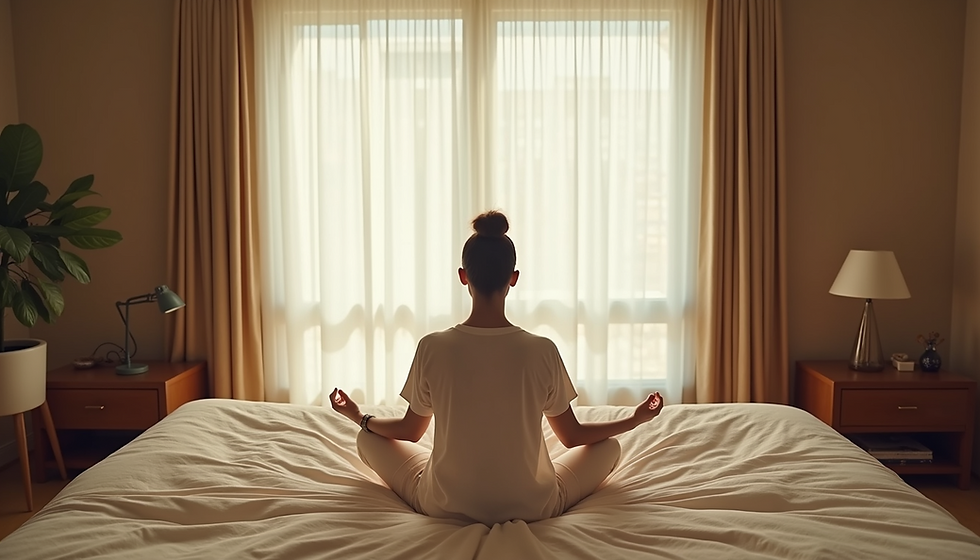
For sleep specifically, the most useful forms of meditation are those
oriented toward relaxation rather than alertness. Yoga nidra (sometimes called "non-sleep deep rest") is worth particular attention — it's a guided meditative practice designed to bring the body into a state of conscious rest, and studies have found it can be deeply restorative even without full sleep. It's available free on YouTube and is a genuinely useful tool for anyone who feels perpetually exhausted but can't seem to sleep deeply.
Where meditation helps: chronic stress, high baseline anxiety, anyone who has tried mindfulness and wants to deepen the practice, people with irregular or disrupted sleep over long periods.
Where to be cautious: meditation is not a quick fix; it works best as a daily practice rather than something you reach for only on a bad night. Some forms of meditation (particularly breath-focused practices) can initially increase anxiety for people prone to panic — choose body-scan or visualisation techniques if that resonates.
The bottom line: meditation is a long-term investment in your nervous system. The sleep benefits are real, but they come from consistency, not urgency.
Therapy for Sleep: The Most Underused Tool in the Room
Here's something the supplement industry would rather you didn't know: for chronic insomnia, the most effective treatment available is not a pill, a spray, or a gummy. It's a structured form of therapy called CBT-I — Cognitive Behavioural Therapy for Insomnia.

CBT-I works by targeting the thoughts and behaviours that perpetuate insomnia. It addresses sleep anxiety ("
I must fall asleep now or tomorrow will be ruined"), unhelpful compensatory behaviours (lying in bed for hours, napping, going to bed early to "catch up"), and the physiological hyperarousal that keeps the cycle going. Multiple meta-analyses have found CBT-I more effective than sleep medication in the long term, with benefits that persist well after the treatment ends.
It's typically delivered over six to eight sessions with a trained therapist, and is increasingly available online through platforms like Sleepio. Some GPs now refer directly to digital CBT-I programmes, making it more accessible than it once was. More general therapy — whether CBT, talking therapy, or other modalities — is also worth considering if your sleep problems are closely tied to anxiety, depression, or ongoing stress. Sleep is rarely an isolated problem. When the underlying emotional load lightens, sleep often follows.
Where therapy helps: chronic insomnia (persistent difficulty sleeping for three months or more), sleep anxiety, insomnia driven by anxiety or depression, anyone who has tried every product and still can't sleep.
Where to be cautious: CBT-I requires commitment and involves some short-term discomfort (particularly sleep restriction, which temporarily limits time in bed). It's not a passive treatment. Access and cost can also be barriers, though online programmes have significantly improved this.
The bottom line: if sleep is a real, ongoing problem — not just the odd bad week — CBT-I is the gold standard. It deserves far more attention than it gets.
Building Your Sleep Ritual: Layering What Works
The honest truth about sleep is that there is rarely one magic solution. The people who sleep well tend to have built an environment and a routine that stacks small advantages: a dark room, a consistent bedtime, a way of signalling to their nervous system that the day is done.
A good sleep ritual might look something like this:
An hour before bed, step away from screens or use blue-light filtering. Begin to dim the lights in your space — your brain responds to environmental cues. If your mind is busy, write down the next day's tasks so they're out of your head and onto paper. Thirty minutes before bed, move through something calming — a short meditation, a gentle stretch, a warm shower. Spritz your pillow with a sleep mist and let the scent begin to work as a sleep cue. Read something light, or simply lie still.

In bed, if your mind wanders, don't fight it. Use a body scan to gently redirect your attention. Let sleep come to you, rather than chasing it.
None of these things are complicated. None of them require a prescription or a significant budget. But done consistently, they build the conditions in which sleep becomes much easier to find.
Ready to Add One More Layer to Your Ritual?
Our Snoozing Angel pillow mist is formulated around Humulus Lupulus (hops) — one of nature's most quietly effective sleep botanicals — alongside lavender and complementary botanicals chosen for their calming properties. No synthetic fragrance. No melatonin. Just a thoughtfully made, science-informed mist that helps your body understand it's time to rest.

Sleep is not a luxury — it's the foundation of everything else. We hope this helps you find yours.


